While change becomes more common, the workforce is increasingly disengaged. Teams struggle with decreased productivity, high turnover and lack of alignment. Many organizations want high-impact, transformative results from people who are already stretched too thin. We’re demanding more from overburdened staff, and asking them less. The result is labelled toxic, dysfunctional, high conflict, low commitment.
These are the perfect conditions for resistance.
The root of resistance; you can’t squeeze blood out of a turnip.
Opposition to change initiatives can take many forms, and often reveals lack of cooperation within an organization. This is common in hierarchical structures, where leadership has a singular vision that leaves little room for creativity from subordinate stakeholders. Seeking to execute unilateral directives is classic command and control, and is can easily become toxic in the networked context of modern business. When we multiply that by the interwoven layers of leadership and stakeholders, it’s no wonder these directives encounter resistance and reduced effectiveness.
Studies consistently show people want to feel like they have an impact, they want to be valued for their skills and given some latitude in how they execute their work. It’s a type of pride in ownership, and it’s easily destroyed when staff are not effectively engaged in decisions that impact their daily work.
People, and their and collective choices, hold power.
As organizations and industry become progressively networked, any given initiative is likely to have diverse stakeholders with a variety of interdependencies. The issues and relationships within them are dynamic, and hold significant power. Alliances and conflict will have a real impact on change management, as do individual and collective behaviors, and need to be thoughtfully considered.
Incentive to cooperate
It’s a natural human tendency to want a choice. A single-minded approach is more likely to encourage opposition because it fails to empower stakeholder voices, and takes away their sense of choice. Suddenly, we have people taking sides and collaboration begins to dissipate. Whether we’re talking about a child defying bedtime, or workers going on strike, the power of choice is undeniable for eliciting cooperation.
As work environments become increasingly interdependent, collaboration is key. Leaders can incentivize cooperation by widening the field of focus. When we provide opportunities for input in decision-making, we naturally empower people. We give them choice, ownership, and a stake in the outcome. When stakeholders are empowered, they are more likely to engage in a collective process, building a deeper understanding of the variety of perspectives and issues at play, and find opportunities to compromise and improve the path forward, together.

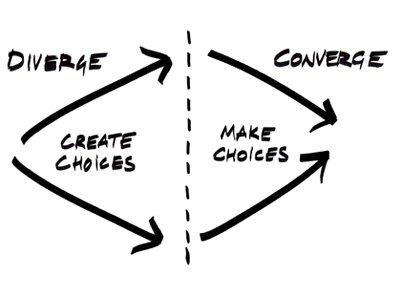
Open the agenda to create choices, and make better choices.
Diverge: Value Mapping
Unlike top-down initiatives, this process requires an opening volley; a leadership sanctioned opportunity for the players to share what matters to them. This is a great opportunity to build perspective and foster inclusion.
Start with asking open ended questions about what could make the initiative attractive and what details are strongly oppose. This simple act of listening is possibly the single most important step in change management, because we begin to create an open space that empowers people in the process.
Bringing stakeholders together and empowering them to collaborate to solve problems promotes learning and understanding. Creating an open dialogue for input helps build awareness and empathy, and allows us to more holistically address the issues under the surface. This also gives people the opportunity to adapt their preferences as they deepen understanding.
Converge: Negotiation
After getting all those values on the table, it’s time to make sense of them, and converge on decisions through collective problem-solving.
When we invite stakeholders to the table, they have an opportunity to benefit from being there. There is nothing to gain by refusing to participate, and this should be clearer after having the chance to give input in a value mapping session. We elicit support and cooperation by giving space and flexibility for people to be part of the decision-making.
The collective process of negotiation reveals many facets, and different parties will agree and disagree on various issues, activating the network of relationships at play. At this point, we’re leveraging interdependencies to support collaboration by creating opportunities for compromise in pursuit of collective gain. The result is a set of mutually beneficial decisions and the ground work for buy-in to build upon.
This process, of opening the agenda to incentivize cooperation, offers instant and potentially long term benefits. Not only does this collaborative process build empowerment and inclusion, it leads to better outcomes by fostering collaboration and gaining sustainable buy-in.
It’s relatively straightforward to pilot a multi-issue agenda for a single initiative that has encountered resistance. The more you begin to practice it, you’ll send a clear message of inclusion and respect to your people. When done effectively, a collaborative process will demonstrate that stakeholder perspectives and input matter, fostering a more cooperative, agile environment over time.
Nimblitz can help you through this journey, through planning, facilitation, leadership training and coaching.